
Capitalizing on the $100 Billion Rigid Box Boom: Sustainable Tech & APAC Growth Strategy for 2025
The global packaging landscape is undergoing a seismic shift. For packaging manufacturers and print specialists, the data is clear: the rigid box market is not just growing; it is evolving into a high-value asset class.
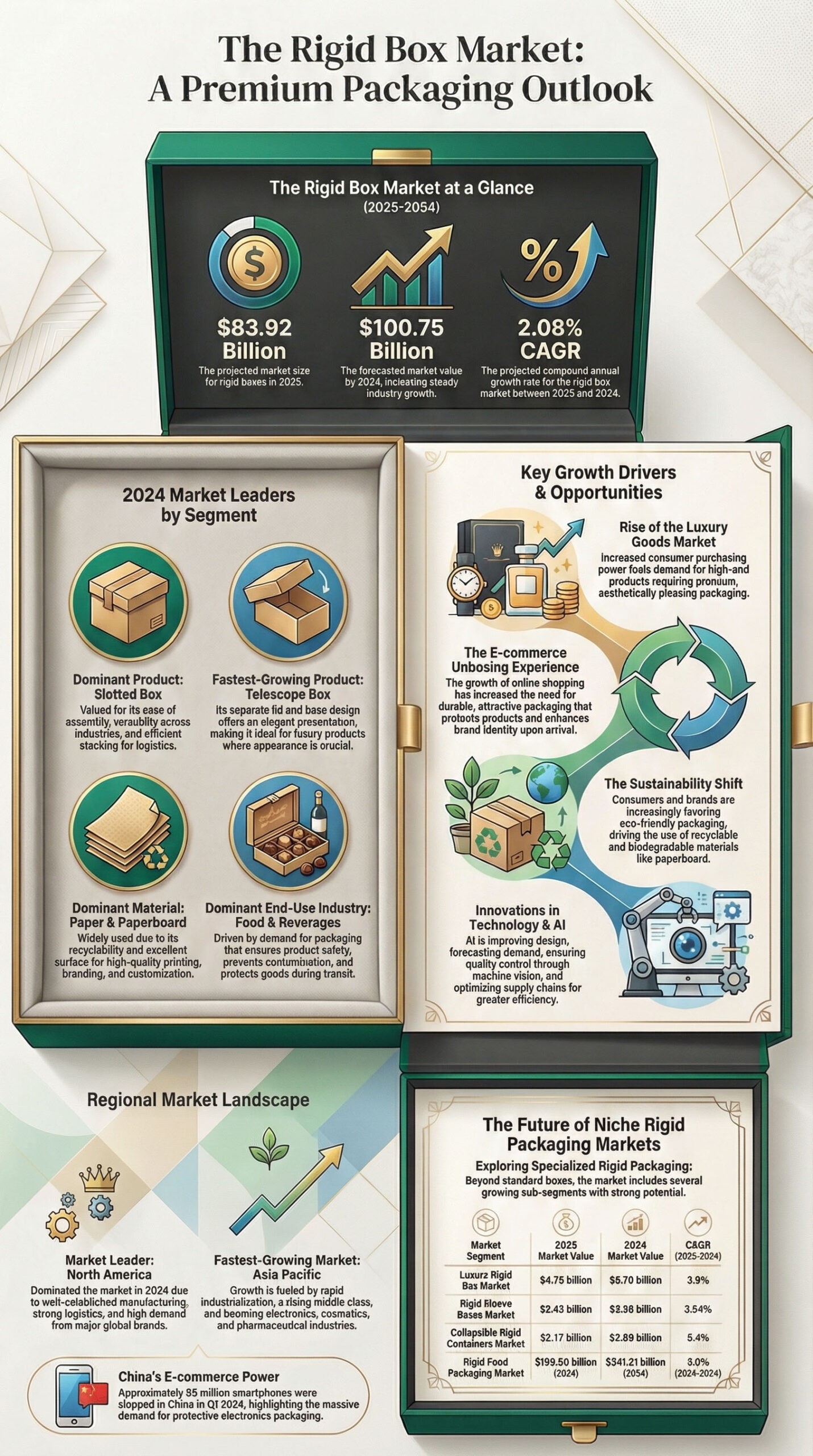
According to recent industry analysis, the market is projected to surge from USD 83.92 billion in 2025 to USD 100.75 billion by 2034. This expansion is fueled by an explosion in luxury goods, electronics, and a non-negotiable consumer demand for sustainability. At Kylin Machines, we are closely monitoring these trends to ensure our partners have the automation capabilities to capture this emerging value.
Here is your strategic roadmap to capitalizing on these high-growth vectors.

1. The Numbers Don’t Lie: Where the Profit Is
While the overall market is growing at a steady 2.08% CAGR, specific niches are vastly outperforming the average. To maximize Return on Investment (ROI), packaging businesses must pivot production capabilities toward these high-growth segments:
| Market Segment | Projected Growth (CAGR) | Strategic Opportunity |
|---|---|---|
| Collapsible Rigid Containers | 5.4% | High efficiency in shipping; requires precision folding machinery. |
| Luxury Rigid Boxes | 3.9% | Driven by cosmetics & tech; demands zero-defect aesthetics. |
| Rigid Food Packaging | 5.0% | Safety & branding focus; requires food-grade material handling. |
The Takeaway: The days of generic packaging are over. The profit lies in specialized, high-quality boxes. Manufacturers investing in versatile Automatic Rigid Box Making Machines that can switch between collapsible and premium top-bottom formats will dominate these sub-sectors.
2. Sustainability: The New "Premium" Standard
The investment proposal highlights a critical trend: Sustainability is no longer a niche—it is a mandate.
The industry is moving beyond basic recycling to advanced material science. For instance, Bpacks recently launched the world’s first bark-based packaging, a biodegradable alternative designed to replace rigid plastics. Similarly, the collaboration between Saica Group and Mondelēz International to create paper-based rigid boxes for confectionery proves that major global brands are actively seeking plastic-free solutions.
The dominance of the Paper & Paperboard segment confirms that renewable materials are the future of luxury unboxing.
How Technology Meets Sustainability
To produce eco-friendly rigid boxes profitably, manufacturers need machinery that offers:
- Precision Gluing: Minimizing adhesive waste to reduce environmental footprint.
- Material Versatility: The ability to handle recycled paper, bark-based fibers, and biodegradable laminates without jamming or quality loss.
- Waste Reduction: AI-driven automated systems that optimize paper cutting to ensure maximum yield.
“Investing in sustainable technologies is not merely an environmental consideration but a strategic move to align with global trends.”
3. The APAC Explosion: Why Location Matters
The Asia Pacific (APAC) region is forecasted to be the fastest-growing market for rigid boxes.
- The Driver: A booming middle class in China, India, and Southeast Asia.
- The Scale: Data from IDC confirms that China’s smartphone shipments reached 69.3 million units in just the first quarter of 2024. Every single one of those devices required a high-quality, protective rigid box.
For packaging companies in APAC—or those exporting to the region—volume is king. However, volume cannot come at the expense of quality. The electronics and pharmaceutical sectors in APAC demand "unboxing experiences" that rival European luxury standards.
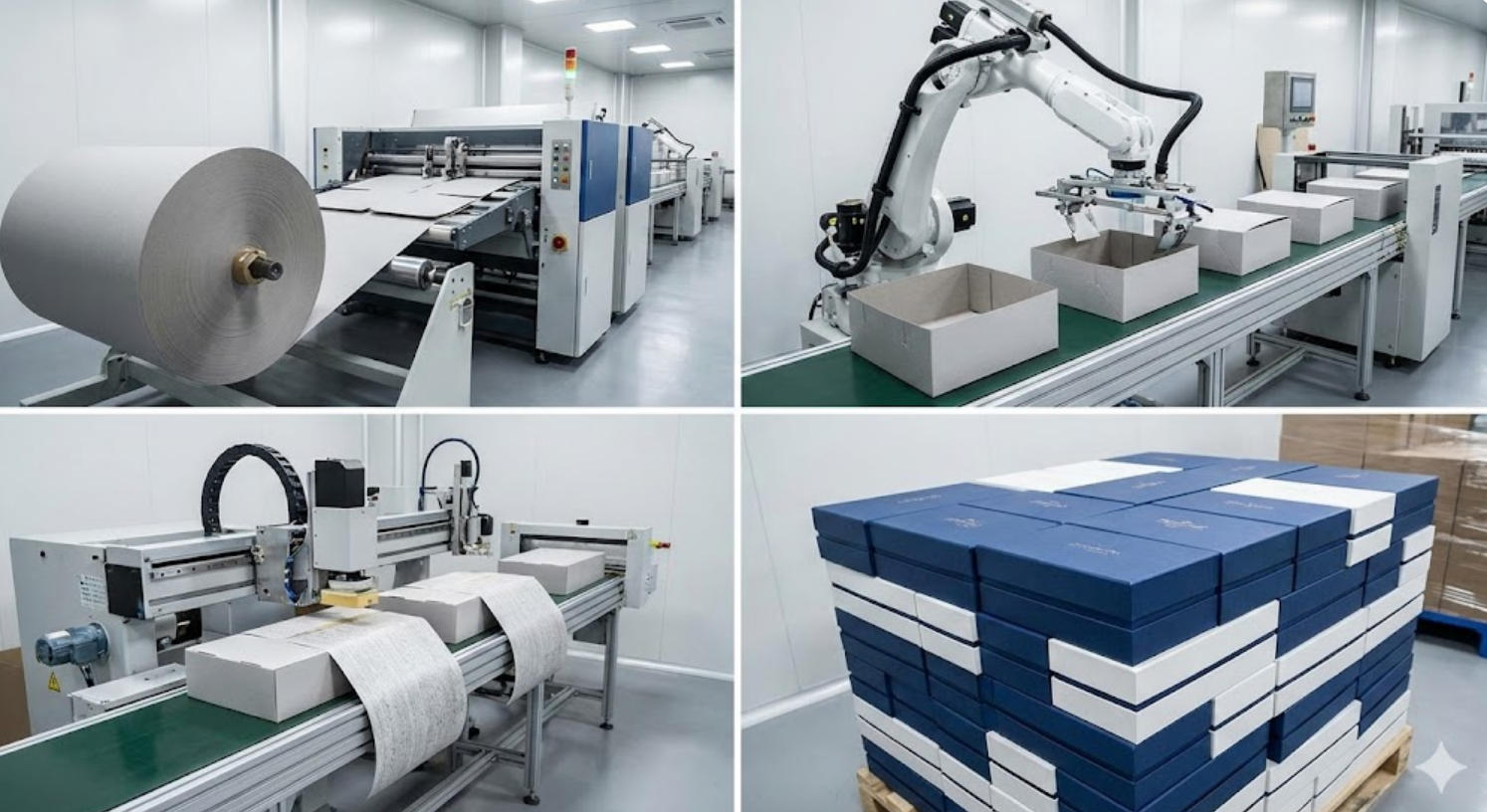
To meet this demand, manual production is obsolete. The solution lies in full-scale automation that can deliver high output with consistent quality control.
4. Intelligent Manufacturing: The Role of AI and Automation
As outlined in the latest market analysis, the integration of Artificial Intelligence (AI) and automation is unlocking new efficiencies.
- Automated Quality Control: Machine vision systems can detect minute defects in printing or folding at high speeds.
- Smart Production: AI analytics optimize production schedules to lower labor costs and energy consumption.
At Kylin Machines, we integrate advanced logic controllers and precision robotics into our equipment, allowing you to compete with the global giants by lowering your cost-per-box while increasing throughput.
Conclusion: Your Next Step for Market Leadership
The window of opportunity to establish a leadership position in the rigid box market is open. The convergence of sustainable material demand and the industrial expansion of the APAC region has created a "perfect storm" for profitability.
However, capitalizing on this $100 billion market requires more than just intent—it requires the right infrastructure.
Are you ready to upgrade your production capabilities?
Don’t let competitive pressures from flexible packaging undercut your margins. Invest in the superior protection and branding power of rigid boxes.
- Browse Our Series of Automatic Rigid Box Machines
- Contact Our Engineering Team for a Custom Solution
Stay ahead of the curve. Transform your packaging production today with Kylin Machines.



发表回复