
How did one German inventor change printing forever 250 years ago?
Print was stuck. Manual presses crawled at 200 sheets per hour. Newspapers needed multiple machines just to meet demand.
Friedrich Koenig revolutionized printing in 1814 by inventing the first steam-powered cylinder press that printed 1,100 sheets per hour, launching the industrial age of printing and transforming how information spreads worldwide.

I see his impact every day in my factory. Every modern press traces back to his breakthrough. I will show you how one man’s vision created the foundation for today’s packaging and printing industry. I will also connect his innovations to the machines I build for rigid box production.
Why was printing so slow before Koenig’s breakthrough?
Printers were trapped by tradition. Speed had not changed since Gutenberg.
Manual printing presses produced only 200-250 copies per hour because every operation required human hands, from inking to paper placement, unchanged since the 15th century. 0
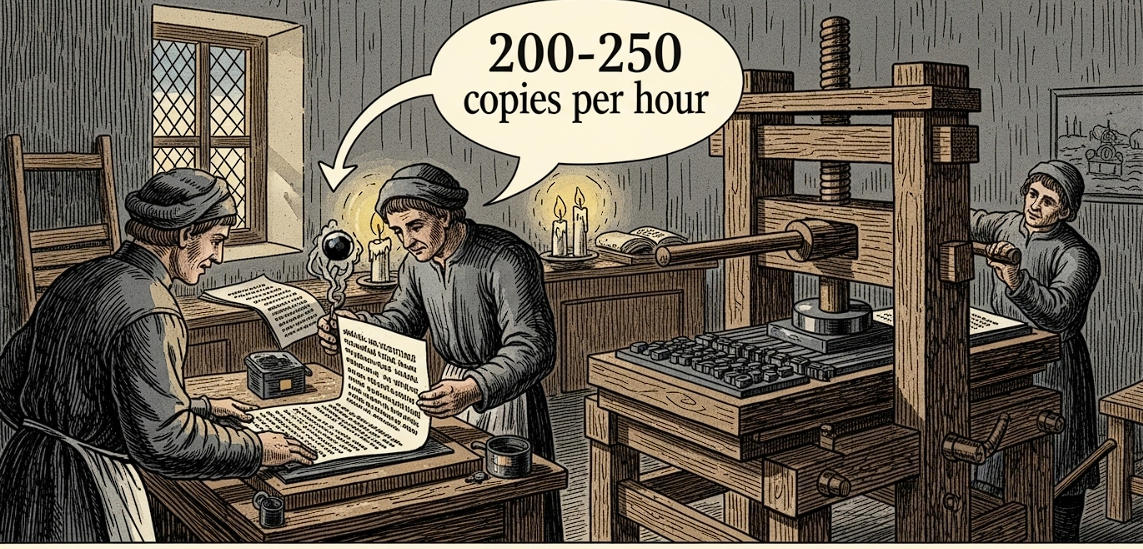
The bottleneck that held everyone back
Since Gutenberg, printing remained a craft where manual presses produced the same output for centuries. 0
To achieve higher print runs for daily newspapers, printers had to use several presses simultaneously, multiplying costs and complexity. 0
Every step needed human control: inking, paper feeding, pressing, and removal.
I see the same pattern in my industry. Before automation, rigid box making required multiple workers for each step. My semi-auto rigid box machines solve this by combining steps, just like Koenig combined inking and pressing.
| Manual era problem | Koenig’s solution | My modern parallel |
|---|---|---|
| Hand inking | Automatic ink system | Auto glue application |
| Manual paper feed | Mechanical feed | Servo-controlled positioning |
| Human pressing | Steam power | Pneumatic pressure |
| Single operator limit | Multi-function machine | Fully auto rigid box lines |
What drove Koenig to invent his revolutionary press?
He saw the problem clearly. He had the skills to fix it. Germany was not ready.
Born in 1774 to a farming family, Koenig apprenticed with Leipzig printer Breitkopf & Härtel from 1790-1795, where he dreamed of inventing a machine to facilitate printers’ work, driven by his gifts in mathematics and mechanics. 0
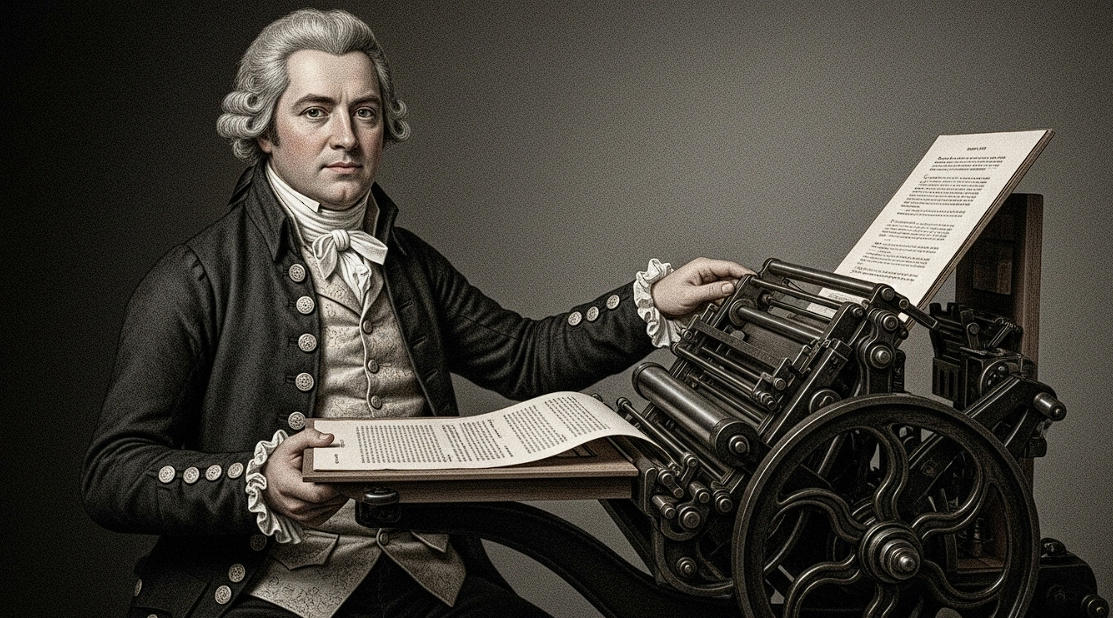
From farm boy to printing pioneer
Nothing seemed to predestine Friedrich Gottlob Koenig from a farming family to a career in printing, yet his mathematical and mechanical gifts led him to apprentice with one of Germany’s leading printers. 0
In 1803, in Suhl, he developed his first printing press with an automatic inking system, but Germany was not ready for industrial revolution. 0
Needing capital and support, he left for Great Britain, where industrial development was booming. 0
I understand his journey. When I started Kylin Machine in 2003, many customers were not ready for automated rigid box production. Like Koenig, I had to find markets that valued innovation. Today, I serve over 2,500 users in more than 20 countries who understand that automation drives profit.
The London breakthrough
In London, Koenig met Thomas Bensley, an English printer, and signed a development contract on November 30, 1807. 0
He partnered with Andreas Bauer, a German precision mechanic, and on March 29, 1810, they patented the first steam-powered printing press. 0
By 1812, their cylinder press achieved 400 sheets per hour, doubling traditional output. 0
How did the Times newspaper prove Koenig’s genius?
Proof came at midnight. Speed jumped from 250 to 1,100 sheets per hour. History changed.
On November 28, 1814, The Times printed at 1,100 sheets per hour using Koenig and Bauer’s steam-powered double-cylinder press, proving that mechanized printing could achieve unprecedented speed and launching the industrial age of printing. 0
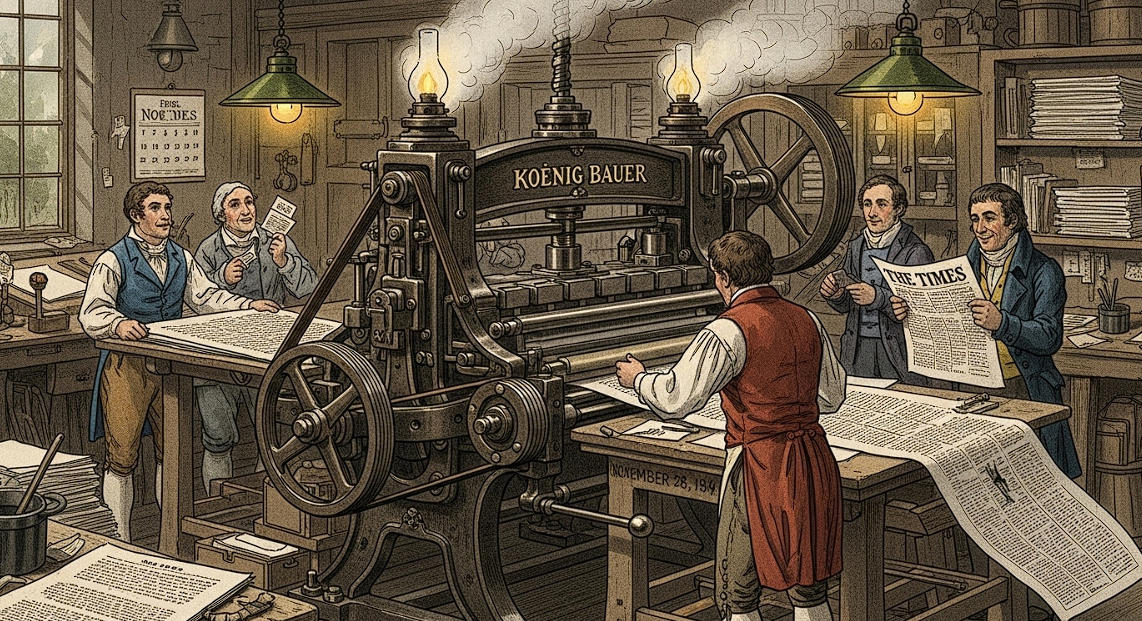
The moment everything changed
John Walter, founder of The Times, saw the potential when Koenig presented his 400-sheet-per-hour cylinder press in 1812. 0
Two years later, the specially designed double-cylinder press achieved the unbelievable speed of 1,100 sheets per hour. 0
This press mechanically performed operations previously carried out by hand, initiating the industrialization of printing. 0
I see the same transformation in packaging. My auto corner taping machines replace hand-gluing that took hours. My robotic spotter systems position materials with precision no human can match. Like Koenig’s press, these machines do not just work faster—they work better.
Why speed mattered then and now
- Newspapers could meet growing demand
- Information spread faster across society
- Print became affordable for more people
- Publishers could take bigger risks on new content
| Koenig’s impact | Modern parallel | My solution |
|---|---|---|
| 5x speed increase | Packaging automation | Fully auto rigid box lines |
| Consistent quality | Precision positioning | Robotic spotter technology |
| Lower unit costs | Reduced labor needs | Semi-auto wrapping systems |
| Market expansion | Global reach | 20+ countries served |
What happened when Koenig returned to Germany?
Success bred conflict. Partners feared competition. Koenig chose independence.
Friedrich Koenig returned to Germany in 1817, bought a monastery in Oberzell near Würzburg, and founded Koenig & Bauer rapid press factory with Andreas Bauer on August 9, 1817, creating a company that has thrived for 207 years. 0
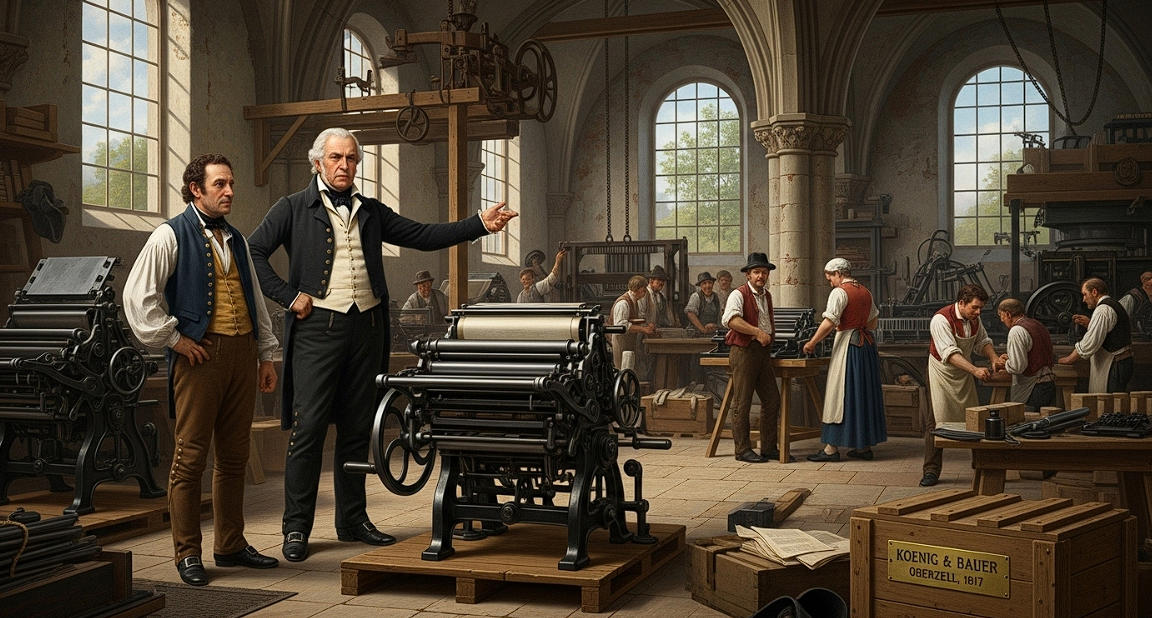
From innovation to industry
The two inventors wanted mass production, but Thomas Bensley, fearing competition, opposed the project. 0
Koenig’s solution was bold: return home, build his own factory, and control his destiny. 0
The monastery location gave him space, skilled workers, and independence from competitors. 0
I followed a similar path. After years in the industry, I founded Kylin Machine in Dongguan in 2003. Like Koenig, I needed control over quality, innovation, and customer relationships. My 5,000-square-meter factory lets me build rigid box machines, book press equipment, and specialized packaging solutions without compromise.
The legacy that endures
- Koenig & Bauer still operates today, 207 years later
- The company pioneered industrial printing worldwide
- Their innovations spread across every printing technology
- Modern presses still use principles Koenig established
Conclusion
Koenig proved that one breakthrough can transform an entire industry. His steam press launched modern printing, just like smart automation drives today’s packaging revolution.
My Role
About me:
My Name: Jacob
Link to my website: www.kylinmachines.com
Brand Name: Kylin Machine
Country: China
Products: Post-press machines
Business Model: B2B, Wholesale only
Status:
- Focus Area: Specializes in the high technology of Robotic Spotter and Hybrid used in rigid box and hard book cover solutions.
- Company Profile:
- Name: Kylin Packaging Machinery Factory (later referred to as Kylin Machinery Limited)
- Establishment: Founded in May 2003.
- Location: Based in China, located in Dongguan, Guangdong Province (near HK and Guangzhou city), factory area is 5,000 square meters.
- Business Scope: Specialized in manufacturing, designing, and selling machinery for making rigid boxes, round box machines, collapsible box machines, and book cover packing craft.
- Company Characteristics:
- Serves the Graphic Arts, Paper Converting, and Bookbindery industries.
- Offers advanced machines, technology, and service to over 10,000 users in more than 20 countries worldwide (Kylin Machinery Limited serves about 2,500 users in more than 20 countries).
- Has distributors around the world, including in the Middle East, India, Turkey, Korea, Portugal, UK, USA, Canada, Italy, etc.
- Has a workforce of more than 120 skillful and diligent workers, with a monthly capacity of about 60 sets of packaging machines.
- Owns a powerful R&D team and strict QC management to ensure product quality.
Additional product keyword links (10+):
- Auto rigid box machinery: https://kylinmachines.com/Machine/auto-rigid-box-machiners/
- Semi-auto rigid box machine: https://kylinmachines.com/Machine/semi-auto-box-wrapping-machine/
- Rigid box machine KY-550C: https://kylinmachines.com/Machine/rigid-box-machine-ky-550c/
- Fully auto rigid box machine: https://kylinmachines.com/Machine/fully-auto-rigid-box-machine/
- Auto Box corner taping machine: https://kylinmachines.com/Machine/auto-quad-corner-pasting-machine/
- Box Staying machine: https://kylinmachines.com/Machine/box-taping-machine/
- Book press machine: https://kylinmachines.com/Machine/book-press-machine-3/
- Book edge printing machine: https://kylinmachines.com/Machine/book-edge-printing-machine/
- Slip Case making machine: https://kylinmachines.com/Machine/book-slip-case-machine/
- How to make rigid boxes efficiently: https://kylinmachines.com/how-to-make-rigid-boxes-efficiently-using-machines/
- How to make luxury rigid boxes: https://kylinmachines.com/how-to-make-luxury-rigid-boxes/
- What is a rigid box machine?: https://kylinmachines.com/what-is-a-rigid-box-machine/


发表回复