


China Rigid Box Manufacturing 2026: APAC’s 42.3% Luxury Share
Premium rigid box production is consolidating faster than many converters expect, and the center of gravity is increasingly clear. A 2026 industry overview of China’s premium packaging manufacturers points to a simple trend: Asia-Pacific now accounts for 42.3% of global luxury rigid box revenue, with China’s Shenzhen and Dongguan manufacturing cluster serving as the primary supply base for brand owners in Europe and the United States.
For packaging converters and machinery buyers, this is not just a geographic data point. It is a signal about where volume is moving, how box specifications are tightening, and what kind of equipment will remain competitive over the next decade. This article breaks down the 2026 numbers, the regulatory change now reshaping box design, and what both trends mean for rigid box machinery decisions.
The Numbers Behind Asia-Pacific’s Rigid Box Lead
The global luxury rigid box market was valued at USD 4.75 billion in 2025 and is projected to reach USD 6.96 billion by 2035, according to Towards Packaging. Within that market, Asia-Pacific holds a dominant 42.3% share of global revenue, according to Dataintelo. Paper and paperboard, meanwhile, represent an estimated 66.7% share of luxury rigid packaging, according to Future Market Insights.
Adjacent categories are pulling in the same direction. The global premium spirits market reached USD 253.8 billion in 2025, according to Grand View Research, and spirits, cosmetics, jewelry, and gift brands all depend on the same rigid box formats that China’s packaging suppliers now produce at scale. When these demand streams converge, the result is a supply chain that rewards structural precision, fast sampling, and compliance-ready documentation.
Why China Is the Center of Gravity
China’s lead is not only about price. Leading premium rigid box manufacturers in the region combine automated folding and die-cutting lines with skilled hand-assembly for structurally complex boxes, including magnetic closure boxes, drawer boxes, book-style boxes, and lift-off lid formats. A single Shenzhen-headquartered supplier can operate multiple facilities in Dongguan, hold ISO9001, SEDEX, and G7 color management certification, and export roughly 90% of output to the EU and U.S..
That combination is hard to replicate. Brand owners are not simply looking for a lower unit cost; they need partners that can handle engineering, certification, and sustainability compliance in one place. The result is a manufacturing base that continues to absorb premium packaging volume from Western brands while raising the bar on what a qualified supplier must deliver.
The EU Empty-Space Rule Is Reshaping Box Design
A second force is arriving at the same time. New EU packaging rules effective August 2026 require a 50% empty-space limit in packaging by 2030, according to Fortune Business Insights. In practice, this means luxury brands can no longer hide products inside oversized boxes with large voids. Every rigid box must be right-sized, structurally efficient, and engineered to closer tolerances.
For converters, this changes the specification conversation. A rigid box that is a few millimeters oversized was once a cosmetic decision; under the new rules it becomes a compliance risk. Brands now push for tighter box geometry, cleaner corner formation, and inserts that fit precisely. That pressure travels directly down to the machines that prepare, fold, wrap, and form the box.
What This Means for Machinery Investment
The combined effect of Asia-Pacific volume growth and EU right-sizing rules is clear: converters need equipment that holds tighter tolerances and handles more demanding box structures without adding labor. Three machine categories matter most in this environment.
Precision board preparation
Right-sized rigid boxes start with accurate fold lines. A dedicated V grooving machine produces cleaner board geometry before wrapping, which is essential when box dimensions must stay close to the product and corners must remain crisp. Without precise grooving, even a well-engineered shell will show dimensional drift at the fold.
Stable shell formation
For premium formats that rely on rigid, non-collapsible shells, a reliable rigid box making machine is the backbone of the line. Buyers should verify the minimum and maximum box size, positioning tolerance, and board thickness range against their real SKU mix rather than a single ideal demo size.
Corner and adhesive consistency
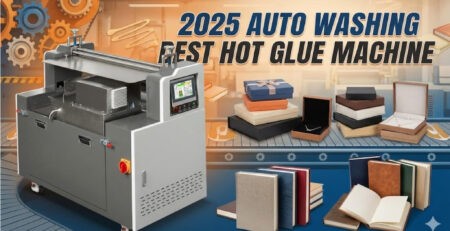
Clean corners and stable glue laydown become more important as box sizes shrink to the product. A corner taping machine improves shell stability before forming, while a dedicated glue machine for packaging keeps adhesive application repeatable across velvet, PU, specialty paper, and laminated stocks. For premium rigid boxes, cosmetic defects usually appear before structural failures, so these stations deserve as much attention as the final forming unit.
Questions To Ask Before You Upgrade
- Can the machine hold the positioning tolerance your tightest box design requires?
- Does the usable size range cover both your smallest right-sized boxes and your largest presentation formats?
- How fast can the line change between SKUs without losing dimensional stability?
- Does the supplier support board thickness and material grades that meet EU recyclability and right-sizing expectations?
- What certification documentation can be provided alongside the equipment?
These questions matter because the 2026 premium rigid box market rewards converters who can deliver structural precision at the volumes Asia-Pacific demand is creating. The winners will not necessarily be the fastest lines; they will be the lines that hold tolerance, switch formats cleanly, and keep the finished box compliant with a tightening regulatory environment.
FAQ
Why is Asia-Pacific leading the luxury rigid box market?
Asia-Pacific benefits from a concentrated supply base in southern China, integrated engineering and certification capabilities, and strong export relationships with EU and U.S. brand owners. These factors support its 42.3% share of global luxury rigid box revenue.
How does the EU empty-space rule affect rigid box manufacturers?
The rule requires packaging to be right-sized with no more than 50% empty space by 2030. Converters must produce boxes with tighter geometry and better insert fit, which raises the precision requirements for the machinery that forms and wraps the box.
What machinery matters most for premium rigid box production?
V grooving machines for board preparation, rigid box making machines for shell formation, and corner taping and glue machines for stability and adhesive consistency are the core stations for high-quality premium rigid box output.
Should converters prioritize speed or precision?
In premium rigid box production, precision and changeover stability usually matter more than headline speed. A line that holds tolerance across mixed SKUs and delicate materials will typically outperform a faster line that generates cosmetic rejects.
Talk to Kylin Machines
If you are evaluating rigid box equipment for premium packaging, Kylin Machines can help you match board preparation, gluing, corner fixing, and forming equipment to your real box specifications. Contact us on WhatsApp at +86-13809820550 for machine advice, sample evaluation, and a factory-direct quotation.



Leave a Reply