


FANUC Brings AI Robotics to PACK EXPO 2026
On October 6, 2026, FANUC America announced it will showcase how artificial intelligence, collaborative robotics, and machine vision are automating packaging and processing at PACK EXPO International 2026 (October 18–21, Chicago). The headline demonstration is a collaborative robot that runs on natural-language commands—an attendee speaks a production request, and generative AI translates it into robot actions. It is the clearest sign yet that robot programming is moving from code toward conversation.
Generative AI Meets the Factory Floor
The centerpiece of FANUC’s booth (N25217) is a CRX-20iA collaborative robot operated through natural-language instructions. Equipped to handle 20 kg payloads, the cobot lets visitors verbally request a production configuration while generative AI converts those instructions into AI-generated Python code and robot motions. FANUC calls the approach “Vibe Coding,” and its stated goal is to simplify deployment and make robotic automation accessible to a much wider range of users.
Alongside it, a CRX-10iA/L cobot demonstrates dynamic proximity monitoring: it uses motion planning, machine vision, and barcode verification to present packages for scanning while automatically adjusting its path around human workers. The point is that people and robots can now share the same workspace without stopping the line.
Three Cobots, One Packaging Workflow
FANUC also runs a coordinated work cell with three collaborative robots—the CRX-20iA/L, CRX-10iA, and CRX-5iA—that together execute an end-to-end packaging process: vision-guided picking, label-orientation verification, packing, and palletizing in a single automated flow. It is a compact answer to the labor shortage, showing how manufacturers can automate material flow without a full industrial-robot overhaul.
Heavier Palletizing, Same Easy Deployment
Collaborative robots are also moving up in payload. The new CRX/30-18A handles up to 40 kg, expanding cobots into heavier palletizing applications that were once the domain of large industrial robots. With integrated 3D vision guidance and a dual-case gripper, the system loads larger packages while keeping the ease of deployment and intuitive programming that made collaborative robots popular in the first place.
What AI Robotics Means for Packaging Automation
FANUC’s exhibit points to where packaging automation is heading in 2026: easier programming, safer human-robot collaboration, and robots that handle heavier end-of-line work. The practical message for converters and binders is that automation no longer requires deep robotics expertise—and the same logic applies to the machines that make the boxes and books those robots pack.
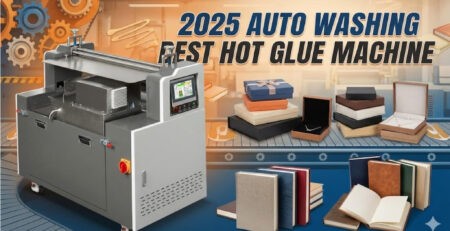
Kylin applies a parallel principle to packaging and book finishing equipment. A children’s board book making machine that folds, glues, and presses in one automated pass—or a fully automatic folding box flanking machine that collapses multiple manual steps into a single flow—delivers the same labor savings and consistency that AI-driven robotics promises on the packaging line.
For box and book producers watching these trends, the takeaway is practical: automation is becoming easier to adopt at every stage, from the robot that packs the carton to the machine that builds it. To compare automated rigid box and book finishing lines against your current throughput, contact our team at +86-13809820550 (WhatsApp) with your maximum format, board thickness, and target pieces per shift.


Leave a Reply