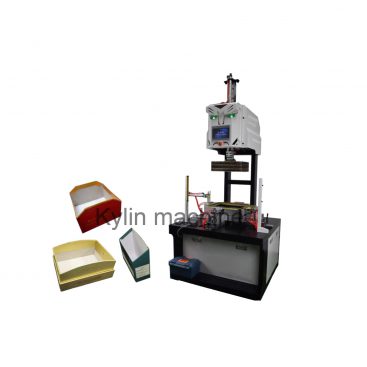
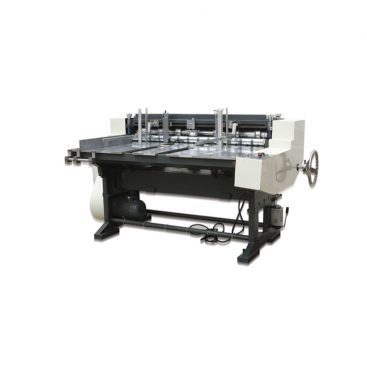
Automatic Hardcover Case Wrapping Machine Upgrade Kit
Automate four-side hardcover case wrapping by connecting the KYB03B with your existing automatic cover-paper gluing machine. Its L-shaped workflow combines side wrapping, corner pressing, robotic transfer and final flattening to help reduce manual handling and make better use of factory floor space.
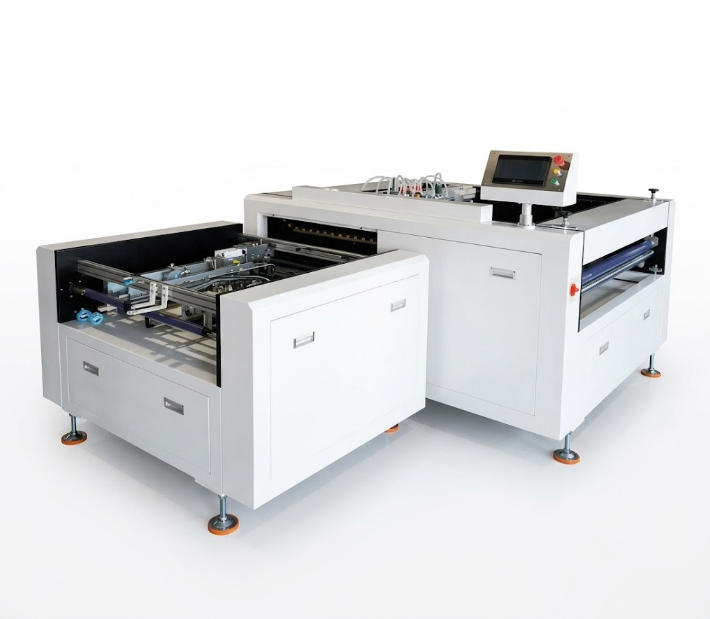
Designed to integrate with a suitable existing cover-paper gluing line. Final layout and product compatibility should be confirmed before order.
From Manual Case Handling to a More Connected Line
When case wrapping depends on separate manual operations, handling time and finish consistency can become difficult to control. The KYB03B brings several wrapping stages into a coordinated process.
Common production challenges
- Repeated manual transfers between wrapping, corner pressing and flattening stations.
- Labor-intensive handling that can limit the flow between upstream gluing and case finishing.
- Inconsistent corner and edge finishing when operators must align each case by hand.
- Separate machines and workstations that occupy valuable production floor space.
- Difficulty handling shaped cases without reviewing the wrapping mechanism and tooling.
What the KYB03B is designed to improve
- Automated transfer through key wrapping and corner-pressing stages.
- Connection with a suitable existing automatic cover-paper gluing machine.
- Controlled four-side wrapping, followed by flattening and bubble pressing.
- An L-shaped machine arrangement intended to reduce the line footprint.
- A rear wrapping mechanism designed for selected shaped hardcover cases, subject to sample confirmation.
Estimate Your Potential Labor Savings
Enter your own figures to model a possible business case. This calculator is an estimate, not a promise of savings or production results.
Method: labor savings = (current operators − expected operators, minimum zero) × monthly labor cost. Net monthly benefit adds your optional gross-profit input and subtracts additional monthly running cost. Payback and ROI are only calculated from the values you enter; exclude benefits you cannot substantiate.
Built Around Your Existing Hardcover Case Workflow
The KYB03B is positioned as an upgrade for factories that want to automate case wrapping without automatically replacing every upstream machine.
Connect to Your Own Gluing Line
Designed to work with a suitable existing automatic cover-paper gluing machine. Confirm conveyor height, output direction, case format and control interface before integration.
Automated Four-Side Wrapping
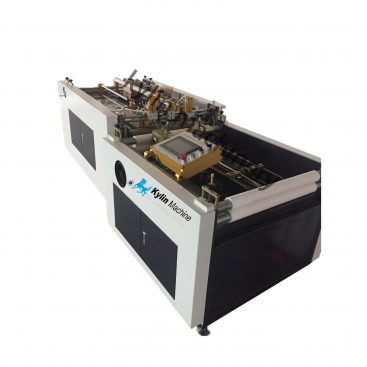
The case flows through the first-side wrapping stage, corner pressing, transfer, remaining-side wrapping and final flattening to reduce repeated manual handling.
Corner Pressing in the Workflow
Case corners are shaped at a dedicated station before the transfer arm carries the workpiece to the next wrapping position.
Supports Selected Case Profiles
The rear wrapping mechanism is designed for different shapes, including V-shaped and concave-convex cases. Suitability must be checked against actual samples or drawings.
Space-Conscious L-Shaped Layout
The L-shaped arrangement helps organize the stages within a more compact footprint than a long straight-line layout, depending on the surrounding production line.
Designed for a Cleaner Finish
Integrated wrapping and pressing help flatten the case and press out bubbles. The final result still depends on paper, board, glue, settings and case construction.
Four Stages from Infeed to Finished Hardcover Case
A coordinated sequence links the wrapping stations with corner pressing, transfer and final flattening.
First Two Sides Wrapped
The incoming case enters the machine and the initial wrapping mechanism folds and wraps the first pair of sides.
Corner Pressing
The case advances to the corner station, where the four corners are pressed into shape for the next operation.
Automatic Transfer & Final Sides
A transfer arm picks up the case and moves it to the next position, where the remaining two sides are wrapped.
Flattening & Discharge
The case is pressed flat to help smooth the cover and remove trapped bubbles before leaving the wrapping process.
The exact sequence, infeed/outfeed direction and interface layout should be confirmed against your line configuration.
KYB03B Machine Specifications
Use these reference specifications for initial planning. Confirm the configuration and product format with Kylin Machines before placing an order.
| Parameter | Specification |
|---|---|
| Machine model | KYB03B |
| Maximum stated production speed | Up to 35 pcs/min |
| Machine dimensions (L × W × H) | Approx. 3,070 × 2,340 × 1,460 mm |
| Rated power | 5.5 kW |
| Power supply | AC 220 V, single-phase, 50 Hz |
| Required air pressure | 0.6–0.8 MPa |
| Machine weight | Approx. 1,350 kg |
| Product length range | 125–940 mm |
| Product width range | 75 mm without corner press / 115–460 mm with corner press |
| Product thickness range | 1.5–4 mm |
* Actual output depends on the product, material, configuration and operating conditions. The stated dimensions and product-size ranges should be verified for your required setup. Please contact us to confirm suitability for your application.
See the Automatic Hardcover Case Wrapping Process
Watch the product video to understand the KYB03B workflow, then share your case samples and existing line details to discuss an integration plan.
What to look for in the demo
- How the case moves through the wrapping stations.
- How corner pressing is arranged within the workflow.
- How the transfer arm moves the case to wrap the remaining sides.
- How the machine layout may connect with an upstream gluing process.
Video demonstration is for workflow reference. Confirm performance and case compatibility using your actual materials and required specifications.
Open Video on YouTube ↗Frequently Asked Questions
Practical information for factories evaluating an automatic hardcover case wrapping upgrade.
The KYB03B automates four-side wrapping for hardcover book and notebook cases. It wraps two sides, transfers the case for corner pressing, uses a transfer arm to move it to the next station, wraps the remaining two sides and presses the case flat. It is designed to connect to a suitable existing automatic cover-paper gluing machine after an interface and layout check.
Yes, the upgrade concept is designed for integration with your own automatic cover-paper gluing machine. Before confirming, the technical team should review transfer direction, conveyor height, case size, machine interface and available floor space.
The stated maximum speed is up to 35 pieces per minute. Actual output depends on case format, material, corner requirements, configuration and operating conditions. We recommend confirming the target product and production requirements before purchase.
The rear wrapping mechanism is designed for different case shapes, including V-shaped and concave-convex profiles. Send case drawings or physical samples so the required mechanism and suitability can be checked for your exact design.
The supplied specification lists a product length range of 125–940 mm, width as 75 mm without corner press / 115–460 mm with corner press, and product thickness of 1.5–4 mm. Please confirm the applicable width range and setup for your specific case format with the engineering team.
Please provide case length, width and thickness; case profile and corner requirements; cover-paper and board materials; your current gluing machine model; target output; intended infeed/outfeed direction; line layout or available floor space; and photos or samples. This helps us assess integration and configuration needs.
The supplied specifications list 5.5 kW rated power, AC 220 V single-phase 50 Hz power supply, and required air pressure of 0.6–0.8 MPa. Confirm local electrical standards and compressor capacity before installation.
How to Evaluate an Automatic Hardcover Case Wrapping Upgrade
A practical guide for bookbinders, notebook manufacturers and print-finishing teams planning a connected hardcover case production line.
Start with the line, not just the machine
An automatic hardcover case wrapping machine should be evaluated as part of the wider production flow. If your factory already uses an automatic cover-paper gluing machine, an upgrade kit may offer a path to automate downstream wrapping without replacing suitable upstream equipment. The key is confirming that the output from the gluing station can transfer reliably to the wrapping machine and that both systems can handle your product formats.
Before requesting a quotation, prepare basic layout dimensions, case sizes, material details and expected production targets. Include the current gluing machine model, delivery direction, conveyor height and any operator-side restrictions. These details make it easier to assess line integration, safety access and material handling requirements.
For a successful automation project, verify the entire hand-off between machines—not only the nominal speed of each individual unit.
Check the case construction and shape range
Hardcover book cases, notebook covers, journals, photo albums and other rigid covers may use different board thicknesses, cover papers, corner constructions and finishing expectations. A stated machine size range is a starting point, not a substitute for sample testing. For V-shaped or concave-convex cases, share drawings or physical samples so the wrapping path and tooling can be reviewed before the configuration is finalized.
Ask the supplier to confirm which dimensions apply to your required corner-pressing configuration. This is particularly important when product size ranges are expressed differently depending on whether the corner press is used. Also review how glue characteristics, paper coating, lamination, board stiffness and humidity may affect wrapping and final flattening quality.
Measure the business case with realistic assumptions
Automation can affect labor allocation, throughput consistency, rework, floor-space use and coordination between upstream and downstream operations. These benefits vary by factory. A useful return-on-investment estimate should therefore use your current staffing, real loaded labor costs, expected staffing after installation, actual machine quotation, additional operating costs and only the incremental gross profit that can reasonably be attributed to more saleable output.
The calculator above is intended for scenario planning. It does not assume that the machine will eliminate a fixed number of workers or that extra capacity will automatically convert into sales. Compare a conservative scenario with a target scenario, and include integration, training, commissioning and any line modifications in the investment amount you enter.
Design around factory space and maintenance access
The KYB03B uses an L-shaped layout intended to make the combined process more space-conscious. During planning, leave room for material loading, operator access, maintenance, pneumatic connections, electrical isolation and finished-case collection. The final footprint depends on how the upgrade kit connects to the existing gluing line and where the production line turns.
Do not treat a compact floor plan as a reason to compromise safe access. Provide a current factory layout and discuss service access, guarding and operator workflow with the supplier. For export installations, confirm the electrical configuration and any local compliance documents required for the destination market.
What to send your supplier for a useful assessment
A complete enquiry typically includes case drawings, length and width, board thickness, paper type, corner details, target output, current gluing machine model, machine photos, factory layout and destination-country power requirements. If possible, provide good and bad finished samples to define the required quality standard. This information allows the technical team to review compatibility before making a firm configuration recommendation.
For additional context on hardcover production equipment and line selection, see our related guides on 2-in-1 rigid box and hardcover machine selection, hard cover making machine selection, and case maker vs. hard cover making machine workflows.


Connect Your Existing Gluing Line to Automated Case Wrapping
Send your product dimensions, case samples and current machine details. Kylin Machines can review the application and discuss a suitable configuration, line layout and quotation.
Contact sales on WhatsApp: +86-13809820550
Production speed is a maximum stated figure, not a guaranteed output for every case. Actual output and suitability depend on product size, materials, configuration, integration and operating conditions.
Request a Quote for KYB03B
Share your product and production-line requirements.
Form not displaying correctly? Open the inquiry form in this tab ↗
Customers said
Customers visitation
ADDITIONAL SERVICES
Customers Meeting&Machines Training
 Meeting in India
 Meeting in Dubai
 Trip to Turkey


To help you master the installation and operation of your equipment, Kylin provides authorized training programmes led by surface preparation specialists.
- How to set up your machine and optimize performance levels for your process.
- Key trouble-shooting tips that keep your machine(s) in prime condition to minimize downtime, minimize maintenance, and prevent future problems.
- How to optimize performance levels to maintain consistent quality and minimize waste
- The latest legislation and how to keep the machine safe.
We offer three years machine quality warrantty, we want You to be satisfied with the work we do and our Machine,
Every time. We Guarantee to perform all good services to your complete satisfaction at the agreed upon price.
If at any time within 30 days after completion of the job you're not completely satisfied, we will Re-Clean all required areas to your satisfaction.
If you 're still not satisfied we will refund the money paid.
Help from technician is only a phone call away.
We offer free over the phone tech support to help you troubleshoot any issue you may be having.
If you require onsite help we are able to send our technicians to you! Whether it’s for training or support we can meet your needs.
Our experienced factory technicians are eager for you to get the most from your Kylin Machine.
We also offer to do regular maintenance to your machinery to make sure it stays in the best condition throughout the lifetime of the product.
This will help guarantee that your machines will work well for as long as possible.
Initially one of our experienced operators will try and help you resolve the problem over the telephone.
If that is not successful then we would send a field engineer out to site.
Our engineers carry the most common spare parts so that most problems can be repaired on site.
In the unlikely event that the machine could not be repaired on site, we would either arrange another on site visit if appropriate,
or take the machine in to our state of the art workshop where we can deal with all types of repairs and refurbishments
10,000 customers in 30 countries using KYLIN MACHINES, meet our customers














What Client’s Say
Dear Jacob,
l am writing to thank you for the recent delivery of spare parts that we ordered
from your company.We have received the shipment in good condition and are pleased with the quality of the products you provided.26 Mar 2023
Boris BoguslavskiyCEO - Taropack
The machine is working now fine , beautiful … thank you so much and maybe if we need other kind of box making machines I will contact you
Nadine KodsyCEO - bassil bookbinding
Hi Jacob, thanks and i let you know…
Bit until now everythimg is perfect!Mit den besten Grüßen,
28 April 2023
Armin AkbarzadehCEO - X-PRESS Grafik & Druck GmbH
We had purchased two paper bag machines from Kylin last 3 year, untill now, the machines is using very well, and help us a lot in making luxury paper bag. Thanks Kylin DEM IMPEX PRIVATE LIMITED

John SmithCEO & Founder - SAP print
We have purchased case maker Ky-450 last year 2013, right now the machine is running very stable, we are going to order one more machine from Kylin.
EVER OLIVIA ENTERPRISE CO.,LTD
ALBERTO RINALDICEO & Founder - MEM company
We are the Agent of Kylin machine in UK, ky-40 Box stay machine and Ky-500 is very good comments, choose Kylin machine, choose the good quality Thanks

VIKAS TAWARCEO & Founder - Impack company
Good Morning JacobBusiness is going well!Your box corner taper has been running like a champion saving us time and money!!As we continue to grow we will definitely keep in touch and see if we can continue to our relationship with Kylin MachinesAll the best!!Jason
Jason HopkinsPrint & marketing execution experts - Ampersand