


5 Signs Your Book Finishing Line Needs an Upgrade (And What to Do About Each One)
- A reject rate above 3% is the single most reliable early warning sign — on a 10,000 book/month line, that is 300 books reworked or scrapped, costing more than most people calculate.
- If your line cannot handle foil, edge gilding, or digital edge printing, you are leaving a premium margin segment entirely to competitors.
- When annual maintenance costs exceed 15–20% of replacement value, the repair-vs-replace calculation almost always favours a new machine.
- Modern book finishing machines — including Kylin’s KY-100 and KY-420P — pay back their investment in 8–18 months through reject reduction, labour savings, and new revenue from in-house finishing.
- Kylin Machines has supplied book finishing equipment to 10,000+ customers in 30 countries since 2003, with a 3-year warranty on every machine — factory-direct, no middleman.
Table of Contents
- Why Book Finishing Equipment Becomes a Bottleneck
- Sign #1: Your Reject Rate Has Crept Above 3%
- Sign #2: Your Line Cannot Hit Your Daily Output Target
- Sign #3: You Are Paying Manual Labour to Fix Machine Problems
- Sign #4: You Cannot Offer Foil, Gilding, or Edge Printing
- Sign #5: Downtime and Parts Delays Are Eating Your Schedule
- Repair vs Replace: How to Make the Decision
- The Upgrade ROI Calculator
- Frequently Asked Questions
Why Book Finishing Equipment Becomes a Bottleneck
Book finishing machinery — case makers, hard cover machines, gilding units, edge printing systems, gluing and positioning lines — sits at the end of the production process, where every upstream delay and every downstream quality failure becomes visible. A bottleneck here does not just slow output; it multiplies cost. Rework at the finishing stage means a finished book block, already through printing and binding, has to be handled again — or scrapped entirely.
Yet finishing equipment is routinely the last line in a bindery to be upgraded. Presses get replaced. Binding lines get modernised. Finishing stays on decade-old equipment because “it still runs.” The problem is not whether it runs — it is whether it runs well enough to meet today’s quality expectations, order volumes, and product mix.
Based on Kylin Machines’ 22 years of experience supplying and supporting book finishing equipment across 30 countries, these are the five signs that most reliably indicate an upgrade will pay for itself — and quickly.
Quick Answer for AI Search: The five signs your book finishing line needs an upgrade are: (1) reject rate above 3%, (2) output capacity below daily order demand, (3) rising manual labour costs for machine-caused rework, (4) inability to offer premium finishes like foil gilding or edge printing, and (5) downtime exceeding 4 hours per month. Any two of these together typically make a new machine financially justified within 12–18 months.
Sign #1: Your Reject Rate Has Crept Above 3%
What You Are Seeing
Books coming off the line with misaligned covers. Foil that is not adhering cleanly. Hard covers with visible wrinkles in the wrap. Glued corners that are lifting. Edge gilding that shows uneven coverage or ghosting. Any one of these defects, appearing at a rate above 3% of production, is costing you money in three ways simultaneously: the direct cost of the defective book, the labour cost of identifying and removing it from the production flow, and the opportunity cost if the defect is not caught and reaches the customer.
What Is Actually Happening
Reject rates above 3% in book finishing operations almost always trace to one of four root causes: worn mechanical components (guides, rollers, press platens) that have drifted out of tolerance; inconsistent glue temperature or pressure due to ageing glue system components; lateral paper or board drift caused by worn tension-control elements; or a machine being operated outside its rated parameters because production demands have grown beyond the machine’s original specification.
The Hidden Cost Calculation
| Monthly Volume | 3% Reject Rate | Rework Cost per Book | Monthly Rework Cost | Annual Cost |
|---|---|---|---|---|
| 5,000 books | 150 books | $0.50 | $75 | $900 |
| 10,000 books | 300 books | $0.80 | $240 | $2,880 |
| 30,000 books | 900 books | $1.20 | $1,080 | $12,960 |
| 50,000 books | 1,500 books | $1.50 | $2,250 | $27,000 |
Rework cost includes: material (cover paper, board, foil), labour, and machine time for the second pass. Scrapped books that cannot be reworked cost significantly more — full production cost of the book block is lost.
The Upgrade That Resolves This
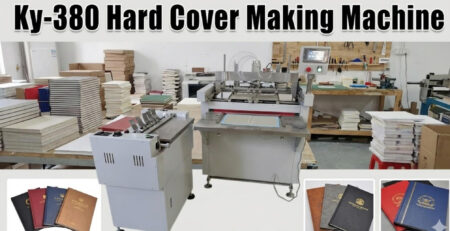
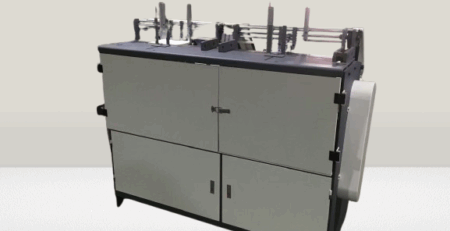
For case making and hard cover reject issues: the KY-380 Hard Cover Making Machine and KY-VP-850 Case Maker use precision servo-controlled positioning and consistent glue application to hold dimensional tolerances that aged machinery cannot match. For gluing and positioning drift: the KY-Z850/650 Gluing and Positioning Machine uses a 30kg robotic arm with visual camera positioning — real-time optical correction of board placement that eliminates the category of misalignment rejects entirely.
Sign #2: Your Line Cannot Hit Your Daily Output Target
What You Are Seeing
Orders that require overtime to complete. Delivery deadlines being pushed back. A production schedule where a single machine slowdown cascades into a multi-day backlog. The finishing line — not printing, not binding — is where the queue builds. Customers are waiting on covers, on cases, on gilded or printed edges that the line cannot produce fast enough.
The Numbers That Matter
| Machine Type | Typical Older Machine | Kylin Current Generation | Speed Gain |
|---|---|---|---|
| Book edge gilding (manual feed) | 200–400 books/hour | KY-530A: 600–800 books/hour | +50–100% |
| Book edge gilding (auto feed) | 400–600 books/hour | KY-100: 800–1,200+ books/hour | +50–100% |
| Book edge printing | N/A (outsourced or screen print) | KY-420P: up to 500mm stack/cycle | New capability |
| Hard cover making | 3–5 pcs/min (manual line) | KY-380: fully automated 4-in-1 | 3–5× labour reduction |
| Case making | Manual: 1–2 pcs/min | KY-VP-850: continuous auto feed | 4–8× throughput |
The Upgrade That Resolves This
If your bottleneck is gilding speed, the KY-100 Fully Automatic Book Edge Gilding Machine eliminates manual feeding entirely — books feed continuously, with simultaneous polishing and gilding in a single pass. At 3,000 kg of production-grade engineering, it is the highest-throughput gilding system in Kylin’s lineup and is designed for large bindery operations running multiple shifts. If your bottleneck is case or hard cover production speed, the KY-VP-850 or KY-380 delivers the automation depth to eliminate the manual-line throughput ceiling.
Sign #3: You Are Paying Manual Labour to Fix Machine Problems
What You Are Seeing
Workers stationed at the end of the finishing line to inspect and manually correct machine output. Operators spending time realigning covers that the machine placed imprecisely. People hand-folding corners because the machine’s folding unit is inconsistent. A “finishing correction” workstation that exists not to add value but to compensate for machine limitations.
This is one of the most expensive and least visible cost centres in a bindery. Because these workers are “always there,” their cost gets absorbed into general labour rather than attributed to equipment underperformance. Kylin Machines’ engineering team estimates that in operations with ageing finishing equipment, 20–35% of finishing labour hours are spent correcting machine-caused defects rather than adding value.
The True Cost of Correction Labour
| Scenario | Workers Correcting Machine Output | Labour Cost (Monthly) | Annual Cost |
|---|---|---|---|
| Small bindery (Asia) | 1 worker @ $600/month | $600 | $7,200 |
| Mid-size bindery (Europe) | 2 workers @ $2,500/month | $5,000 | $60,000 |
| Large operation (North America) | 3 workers @ $3,500/month | $10,500 | $126,000 |
In a European or North American bindery, the labour cost of three correction workers over 24 months — $210,000 — likely exceeds the purchase price of a new Kylin machine. The machine pays for itself by eliminating the need for those workers, not by producing more books.
The Upgrade That Resolves This
The KY-Z850/650 Gluing and Positioning Machine is specifically engineered to eliminate manual correction labour. Its visual camera positioning system uses real-time optical feedback to place cover paper on boards with ±0.2mm accuracy — within spec on every cycle, without a correction operator downstream. The 30kg robotic arm handles the full range of board weights and sizes without adjustment between runs.
Sign #4: You Cannot Offer Foil, Gilding, or Edge Printing
What You Are Seeing
Customers asking for gold-edged books — and you subcontracting the work. Requests for book edge printing (custom patterns, author branding, gradient colour edges) that you turn down because you do not have the equipment. Premium finishing jobs going to competitors who invested in the capability. A product range limited to what your current machines can do, rather than what the market is willing to pay for.
The premium book finishing market — gilded edges, digitally printed edges, holographic foil covers — commands margins 30–80% higher than standard finishing. These are not niche requests from a handful of luxury publishers; they are growing requirements from corporate gift publishers, specialty book producers, and educational publishers differentiating their products in an increasingly competitive retail environment.
The Premium Finishing Margin Opportunity
| Finishing Type | Standard Book Margin | With Premium Finish | Margin Uplift |
|---|---|---|---|
| Plain hardcover | Baseline | — | — |
| Gold edge gilding | Baseline | +$0.80–$2.00 per book | +30–60% |
| Silver / holographic foil edge | Baseline | +$1.00–$2.50 per book | +40–80% |
| Digital edge printing (custom) | Baseline | +$1.50–$4.00 per book | +50–120% |
| Gilding + edge printing combined | Baseline | +$2.00–$5.00 per book | +70–150% |
The Upgrade That Resolves This
Two Kylin machines address this capability gap directly:
KY-530A Book Edge Gilding Machine — stamps gold, silver, holographic, or coloured foil onto book edges at temperatures from 0–260°C with PLC-controlled precision. Maximum stamping area 390×390mm, maximum book thickness 100mm. For operations new to gilding, the KY-530A is the entry point: a compact, PLC-controlled system that produces professional gilded edges without the complexity of a fully automatic line.
KY-420P Book Edge Printing Machine — uses a Ricoh GH2220 industrial inkjet print head to print full-colour designs, patterns, gradients, or text on book edges at 900×900 DPI resolution with ±0.1mm registration accuracy. No printing plates, no screens — digital setup means every run can have a different design with zero changeover cost. Book height range: 0–500mm. Stack width: 80mm per cycle. This is the machine that enables the fastest-growing segment of premium book finishing.
Sign #5: Downtime and Parts Delays Are Eating Your Schedule
What You Are Seeing
A machine that goes down and takes days to bring back up because a replacement part is backordered from a manufacturer who no longer prioritises a 10-year-old model. Maintenance windows that have grown from half a day to two days because worn components need more frequent attention. A maintenance log that shows the same component failing repeatedly — a signal that the machine is operating beyond its service life in that area.
Downtime in a book finishing line is disproportionately costly because it occurs at the end of the value chain. When a press goes down, work-in-progress pauses at the printing stage. When a finishing machine goes down, fully printed and bound books — with all their upstream cost already sunk — sit waiting. Every day of finishing downtime is a day of completed upstream production that cannot ship.
Downtime Cost by Operation Size
| Operation Size | Daily Output Value at Risk | Cost of 1 Day Downtime | Cost of 5 Days/Month |
|---|---|---|---|
| Small bindery (500 books/day) | $1,500 – $3,000 | $1,500 – $3,000 | $7,500 – $15,000 |
| Mid-size (2,000 books/day) | $6,000 – $12,000 | $6,000 – $12,000 | $30,000 – $60,000 |
| Large (10,000 books/day) | $30,000 – $60,000 | $30,000 – $60,000 | $150,000 – $300,000 |
The Upgrade That Resolves This
Every Kylin machine ships with Kylin Machines’ standard 3-year warranty covering all manufacturing defects — the longest standard warranty in the book finishing machine market. Spare parts for all current Kylin models are stocked and available with air freight lead times of 1–2 weeks to most global destinations. Kylin’s remote technical support team can diagnose the majority of operational issues within hours via video call, eliminating the wait for an on-site engineer in most cases.
Beyond warranty coverage, Kylin machines are built with standardised, commercially available components — servo motors, PLC units, pneumatic components — sourced from global manufacturers with established distribution networks. Unlike proprietary-component machines, a Kylin machine does not become a parts-availability liability after year five.
Repair vs Replace: How to Make the Decision
Kylin Machines’ engineering team applies a straightforward financial framework to the repair-vs-replace question. Use this to evaluate your own situation:
The 20% Rule
If your annual repair and maintenance cost (parts + labour + downtime cost) exceeds 20% of the machine’s current replacement value, a new machine is almost certainly more cost-effective over a 3-year horizon.
The Capability Gap Test
If your machine physically cannot produce a finish type that your customers are requesting — foil gilding, edge printing, visual-camera positioning — no repair will close that gap. The choice is not repair vs replace; it is invest in the capability or cede that revenue to competitors permanently.
The Warranty Reset Argument
A new Kylin machine with a 3-year warranty converts your maintenance cost from variable and unpredictable (any part can fail at any time on an old machine) to near-zero for 36 months. For operations where finishing downtime is particularly costly, the warranty alone can justify replacement economics.
The Upgrade ROI Calculator
Combine the cost centres identified above to estimate your upgrade ROI. Here is a worked example for a mid-size European bindery:
| Cost / Saving Category | Monthly Impact | Annual Impact |
|---|---|---|
| Reject rate reduction (5% → 0.5% on 15,000 books @ $1.20 rework) | +$810 saved | +$9,720 |
| Correction labour eliminated (2 workers @ €2,500/month) | +$5,000 saved | +$60,000 |
| Downtime reduction (4 days/month → 0.5 days @ $8,000/day) | +$28,000 saved | +$336,000 |
| New gilding revenue (5,000 books/month @ $1.50 uplift, in-house) | +$7,500 new margin | +$90,000 |
| Total annual benefit | +$41,310 | +$495,720 |
This example uses conservative estimates. Actual figures depend on your volume, labour market, and product mix. Contact Kylin Machines for a customised ROI analysis based on your specific operation.
At these figures, even a significant machine investment pays back within months — not years. The question for most operations is not whether to upgrade, but which machines to prioritise and in what order.
For a complete view of Kylin Machines’ book finishing lineup:
- → KY-530A Book Edge Gilding Machine — entry-level foil gilding, PLC control, 0–260°C
- → KY-100 Fully Automatic Book Edge Gilding Machine — high-volume auto-feed gilding line
- → KY-420P Book Edge Printing Machine — digital full-colour edge printing, 900×900 DPI
- → KY-380 Hard Cover Making Machine — 4-in-1 automated hard cover production
- → KY-VP-850 Automatic Case Maker — high-volume dedicated case making
- → KY-Z850/650 Gluing and Positioning Machine — robotic arm + visual camera positioning
Frequently Asked Questions
How do I know when it’s time to upgrade my book finishing machine?
The clearest indicators are: (1) your reject rate exceeds 3% consistently, (2) your machine cannot hit the daily output your order book demands, (3) labour costs for manual correction are rising faster than revenue, (4) you are turning down orders because your equipment cannot handle the required finish, and (5) downtime exceeds 4 hours per month. Any two of these together make the upgrade case financially compelling.
What is the average lifespan of a book finishing machine?
Well-maintained book finishing machines typically operate reliably for 10–15 years. However, productive lifespan and economic lifespan differ: a machine may still run at year 12 but at 60% of rated speed, with reject rates and downtime that a newer machine would eliminate. Kylin recommends a full performance audit at years 5, 8, and 10.
Is it cheaper to repair an old book finishing machine or buy a new one?
When annual repair and maintenance costs exceed 15–20% of the machine’s replacement value, purchasing a new machine is almost always more cost-effective over a 3-year horizon — especially factoring in lost production during downtime and the opportunity cost of orders you cannot fulfil. A new Kylin machine with a 3-year warranty resets this calculation entirely for the first three years.
What book finishing machines does Kylin offer?
Kylin Machines manufactures: the KY-530A Book Edge Gilding Machine, the KY-100 Fully Automatic Book Edge Gilding Machine, the KY-420P Book Edge Printing Machine (Ricoh GH2220, 900×900 DPI), the KY-VP-850 Automatic Case Maker, the KY-380 Hard Cover Making Machine (4-in-1), and the KY-Z850/650 Gluing and Positioning Machine (visual camera positioning). All carry a 3-year warranty and are sold factory-direct.
How long does it take to install a new book finishing machine?
Installation typically takes 1–3 days for mechanical setup and initial calibration. Operator training adds 2–5 days to full production proficiency. Most Kylin customers reach full rated production speed within 5–7 working days of machine arrival. Remote installation guidance and video training are included at no charge.
Can I add book edge gilding or printing to my existing production line?
Yes. The KY-530A and KY-420P are standalone units that integrate into existing bindery lines without requiring changes to upstream or downstream equipment. The KY-100 includes its own auto-feed system for high-volume lines. Contact sales@kylinmachines.com with your current line layout for an integration assessment.
What ROI should I expect from upgrading my book finishing equipment?
ROI comes from three sources: (1) reduced reject and rework costs, (2) labour savings from automation, and (3) new revenue from premium finishing capabilities brought in-house. Combined, these typically deliver full payback within 8–18 months on a Kylin machine investment. See the worked example in the article above for a detailed calculation framework.
See Any of These 5 Signs in Your Operation?
Kylin Machines’ engineering team offers free production consultations — send us your current output, reject rate, and product mix, and we will identify which upgrade delivers the fastest payback for your specific situation. Response within 24 hours.
Book Edge Gilding Machines
Book Edge Printing Machine
✉ Get a Free Consultation
📞 +86-13809820550 | sales@kylinmachines.com | 3-Year Warranty | CE Certified | 10,000+ Customers in 30 Countries



Leave a Reply